
Be Like the Cockroach: Thriving Through Massive Change

As AI reshapes industries and fuels uncertainty, the real question isn’t whether change is coming. It’s whether we can adapt without surrendering who we are. A reflection on resilience, identity, and navigating massive change.
I have been thinking a lot about AI lately.
Not just the excitement around it, and not just the fear, but the deeper current running beneath both.
Companies are investing hundreds of billions of dollars. Data centers are rising across the country. Entire industries are retooling in real time. At the same moment, there is quiet anxiety that jobs will disappear, that professions will shrink, and that the economy may not look anything like it does today.
I have been cautiously enthusiastic about AI since the beginning. When ChatGPT first became available, I started using it early. Not because it was trendy, but because I saw it as a transformative tool. A way to think more clearly. A way to write more precisely. A way to become more efficient so I could spend more time doing the human work that actually matters.
Recently, though, the tone around me has shifted. What once felt experimental or playful now feels inevitable. And inevitability creates fear.
Over Mardi Gras, standing outside in perfect New Orleans weather, I probably laid eyes on over 100,000 people. Families, professionals, retirees, students, tourists. At one point I found myself wondering how many of them are genuinely worried that AI will turn their lives upside down. My guess is not many.
One very interesting conversation during that time stayed with me that had nothing to do with AI, but in retrospect is so relevant to what I am seeing and hearing about AI today.
I was speaking with a retired engineer who spent his entire career in the oilfield. He lived through multiple catastrophic downturns in the 1970s, the 1980s, the 1990s, and beyond. Entire segments of the industry contracted. Regions slowed down. Budgets were slashed. Scores of people were laid off.
He told me that early in the oil crisis of the 1970s, a mentor pulled him aside and said:
We have to be like cockroaches if we want to thrive.
At first, it sounds crude, but what he meant was profound.
He did not cling to one narrow role. He remained an engineer, but he worked in many different areas of the business. When one division slowed, he moved to another. When one geography dried up, he relocated. He and his family lived in different parts of the world. He adapted to whatever the environment demanded.
He never stopped being an engineer for the same company in the same industry. He never surrendered his identity. He adjusted how he operated so he could keep providing for his family through multiple downturns.
That is the point.
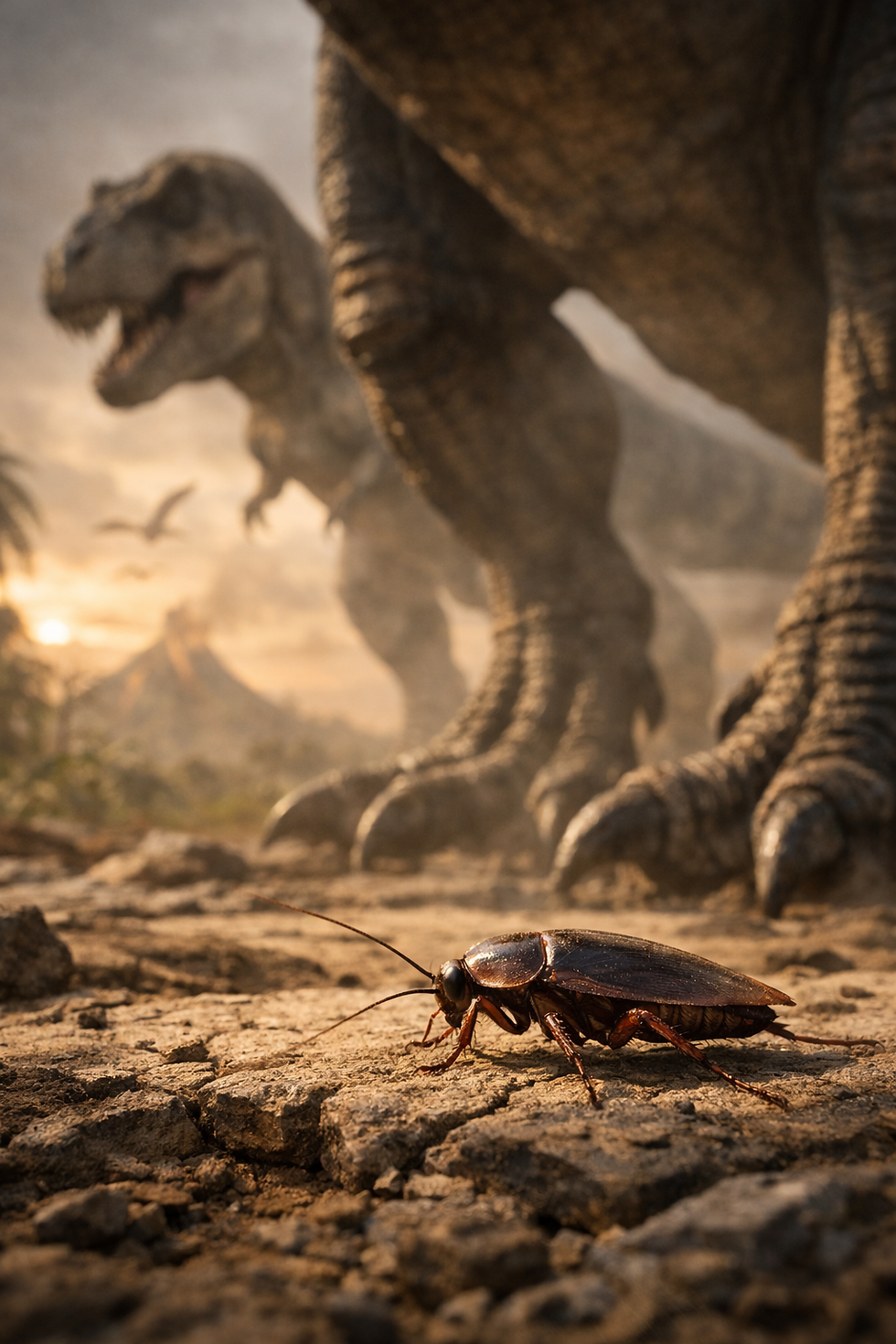
Cockroaches appear in the fossil record more than 300 million years ago. They thrived many millions of years before dinosaurs and survived multiple extinction events that wiped out entire branches of life. The same bug that thrived before frogs evolved from fish now thrives in our pantries. They survived asteroids, super volcanoes, global freezes, and now widespread use of pesticides. They will undoubtably be around long after humans are gone.
What is remarkable is not that they constantly reinvented themselves. It is that they largely remained the same while adjusting to radically changing environments.
They adapted without losing their core identity. That distinction feels especially important right now.
In moments of massive change, the fear is often that we must become something entirely different. That survival requires reinvention.
Oftentimes, it just requires adaptation.
You can remain who you are while adjusting how you operate.
AI does not require you to abandon your values. It does not require you to surrender your principles. It does not require you to give up your humanity. It may require you to learn new tools. It may require you to rethink how you deliver value. It may require you to let go of certain tasks that once defined your daily routine.
But you can remain you.
In my own life, I have faced moments where giving up would have been easier.
After my car accident at 19, my injuries were severe. I could have abandoned my ambitions. I could have decided that chronic pain and physical limitation meant my dreams were unachievable. I could have applied for disability and let the story end there.
That would have required me to evolve into someone entirely different than who I am.
Instead, I adapted. I adapted to getting through college without the ability to walk for 3 years. I adapted to law school with a spinal injury. I adapted to pain, uncertainty, and physical limits. I remained driven. I remained convicted. I remained myself.
Later, in toxic work environments, I faced different kinds of pressure. I could have survived by becoming someone I am not. I could have abandoned my principles, surrendered my agency, and complied in ways that slowly reshaped my character.
That would have been a form of evolution.
Instead, I adapted again. I stayed true to myself and changed my environment. I built something aligned with who I already was. I did not become someone else in order to survive. I adjusted to my surroundings so I could remain intact. I was in a sense, "being like a cockroach."
Adaptation is the difference.
Evolution of self is not inherently bad. Sometimes becoming a totally different version of yourself is necessary and healthy, but there is a dangerous kind of evolution that happens when life beats you down until you abandon your core values, convictions, and purpose.
For those who truly know themselves, massive change does not require surrender.
It requires flexibility.
AI will eliminate tasks. It may reshape industries. It may create volatility. History is full of similar moments. Mechanized agriculture replaced hand harvesting. Steam engines replaced horses. Petroleum engines replaced steam and sails. Satellite communication replaced handwritten letters. Streaming replaced cable. Entire industries contracted while others expanded.
Those who adapted continued forward.
Those who refused to adapt struggled.
The lesson is not panic.
The lesson is to be adaptable.
Stay rooted in who you are. Stay anchored in your purpose. Learn the tool. Adjust how you operate. Remain principled. Remain human.
Be like the engineer who remained himself and adapted through multiple oil busts.
Be like the cockroach that is essentially the same as it was before T-Rex ruled Earth.
Not dramatic. Not constantly reinventing itself.
Just steady. Resilient. Adaptable.
The dinosaurs are gone.
The cockroaches remain.
AI will change the world. That is almost certain.
Whether it changes who you are is, to a large extent, up to you.


Comments